


No products in the cart.
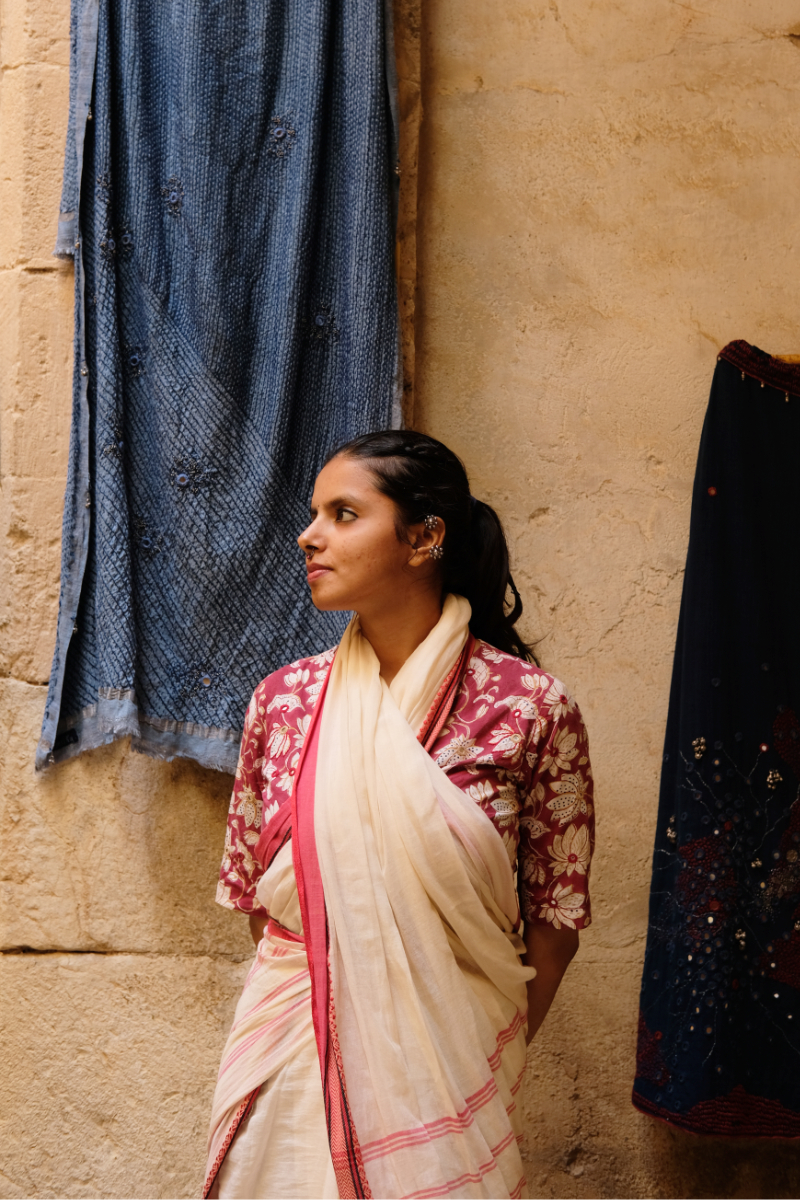
Hansika Sharma is a textile artist who transforms cloth into sites of quiet intensity, where material becomes memory, and process becomes a form of prayer. Working with indigo and hand embroidery, her practice moves between the tangible and the intangible, weaving together personal experience, human behaviour, and a deep, ongoing spiritual inquiry.
Her work begins in observation of people, of movement, of the subtle emotional undercurrents that shape how we exist in the world. Having grown up in constant transition, she developed an acute sensitivity to patterns: in relationships, in environments, and within herself. These patterns now reappear in her textiles, not as fixed narratives, but as evolving forms fluid, layered, and alive.
Indigo, at the heart of her practice, is more than a medium it is a collaborator. Its slow, unpredictable nature demands surrender, inviting a process that is as much about letting go as it is about making. Each immersion into dye is an act of trust; each emergence, a revelation. Paired with intricate hand embroidery, her works carry a palpable sense of time stitched, absorbed, and held within the fabric.
There is a rhythmic devotion to her process. Repetition becomes meditation. Marks accumulate like breaths. Surfaces build into landscapes that feel at once intimate and expansive echoing the inner terrains we all navigate but rarely articulate.
Hansika’s work is driven by a fascination with dualities: chaos and stillness, fragility and strength, the masculine and the feminine. Rather than resolving these tensions, she holds them allowing them to coexist, to inform one another, to dissolve into something more unified. Inspired by fractal geometries and organic systems, her compositions suggest that what exists within us is never separate from what exists beyond us.
At its core, her practice is an act of seeking of creating objects that do not offer closure, but invite contemplation. Her textiles become spaces to pause, to reflect, to feel. They ask for time. They hold silence. And within that silence, they open up the possibility of connection between self and material, body and memory, the seen and the unseen.